
Weekly Gantt Chart in Excel
One column per week, so months of work fit on one screen. In Gantt Excel it’s a view of the plan you already have. Open More Views, click Weekly View, and the same plan redraws by the week, with every date left exactly as it was.
Runs in Microsoft Excel. Nothing to install, no account.
01 When a weekly Gantt chart is the right zoom
Each column is one Monday-to-Sunday week. You lose the exact day each task starts, and in return the whole project fits on one screen. For anything from about six weeks to about six months long, that’s usually the view you want.
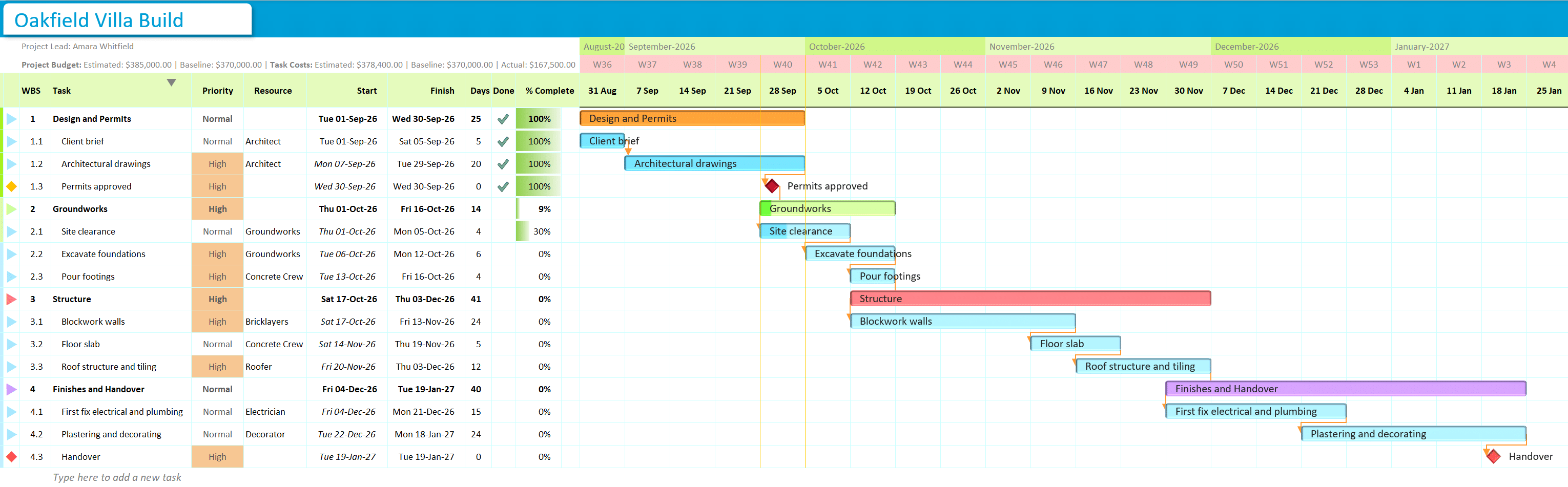
The villa build on this page runs for about four and a half months. By the day, that’s 141 columns and a lot of sideways scrolling. By the week, it’s 21 columns, which fits on a laptop.
| View | One column is | Good for |
|---|---|---|
| Daily View | One day | The working view for a project of a few weeks. This week’s jobs, who is on site tomorrow. |
| Weekly View | One week, Monday to Sunday | A quarter or two on one screen. Planning meetings, a stand-up that looks further than Friday. |
| Monthly View | One calendar month | A year or two. The usual view for a status report. |
Most people end up using two of these, not one. Daily View while you build the plan and chase this week’s work, Weekly View when someone asks what the next three months look like. Switching is one click and changes nothing in the plan, so there’s no reason to pick one and stick with it. The monthly Gantt chart page covers the view above this one, and hourly planning the one at the other end.
02 Switch any chart to Weekly View
There is no weekly template to find. Every Gantt Excel chart can be shown by the week, including one you built last year in Daily View.
- On the Gantt Excel tab, find the Views and Timeline group.
- Click More Views and choose
 Weekly View, the green W at the top of the list. The header redraws in weeks and every bar is redrawn against the new columns.
- Click Show Full Timeline. It fits the whole project on screen, from the Monday of the first week to the Sunday of the last.
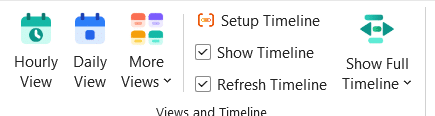
Weekly View lives under More Views, beside Monthly, Quarterly, Half Yearly and Yearly.
Make the weeks wider or narrower
Setup Timeline opens a dialog with one column width per view. The Weekly box is the one that matters here. Each view remembers its own width, so a comfortable weekly width doesn’t squash your daily one. Narrow it to see more weeks at once, widen it when the bar labels start to crowd.
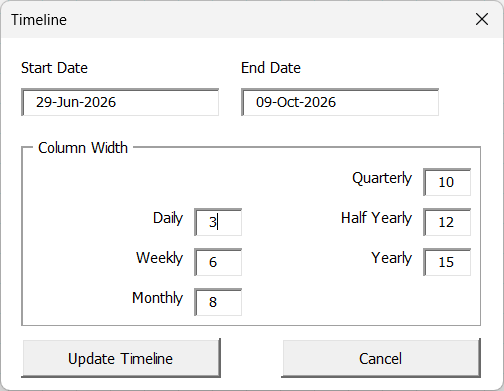
The Start Date and End Date in this dialog only change how much of the timeline you see. They don’t move any tasks.
03 Reading the header: month, week number, Monday
The timeline header has three rows, and in Weekly View they read from the widest unit down.
- Top row: the month
- Printed where a new month begins, such as September-2026, so you can see where one month hands over to the next.
- Middle row: the week number
- Printed as W36, W37 and so on. These are ISO week numbers, the international standard.
- Bottom row: the Monday
- The date each week starts on, such as 7 Sep. This is the row to read when you need a date.
ISO weeks always start on a Monday. Most years have 52 of them, but some have 53, and 2026 is one. You can see it in the chart at the top of this page: the week starting 28 December is W53, the next one is W1, and plastering runs straight across both. If your own chart shows a W53, it’s correct.
Daily View prints the same week numbers above each Monday, so a week number read off one view matches the other.
04 The villa build, week by week
This is the project the rest of this site uses: the Oakfield Villa build, led by Amara Whitfield. Here it’s the full programme, about four and a half months from the client brief to handover. The crews work Monday to Saturday, and each task starts when the one before it finishes. By the week, it reads as four phases:
| Phase | Runs | Weeks |
|---|---|---|
| Design and Permits | 1 to 30 Sep | W36 to W40 |
| Groundworks | 1 to 16 Oct | W40 to W42 |
| Structure | 17 Oct to 3 Dec | W42 to W49 |
| Finishes and Handover | 4 Dec to 19 Jan | W49 to W3 |

The timeline on its own. Every column is a Monday-to-Sunday week, headed by its Monday.
Why a four-day task can look two weeks long
In Weekly View a bar fills every week it touches. Two tasks on the villa show the difference:
- Pour footings takes four working days, Tuesday to Friday of the same week. Its bar is one column wide.
- Site clearance also takes four working days, but runs Thursday to the following Monday. It crosses a weekend, so it touches two weeks and its bar is two columns wide.
Both are right. The bars show which weeks a job lands in. For the exact days, read the Start and Finish columns, which never round.
For a shorter version of the villa build drawn by the day, see the construction Gantt chart page.
05 The schedule still counts working days
A view is only a way of looking. It doesn’t change how Gantt Excel does its sums, and this catches people out when they expect a weekly chart to plan in weeks.
- Durations stay in working days. A job that takes three working weeks on a Monday-to-Friday calendar is a duration of 15, whichever view is on screen. Type the start and the duration and let the finish date work itself out around weekends and holidays. On the villa, Blockwork walls is 24 working days: four six-day weeks.
- Links behave exactly as they did. Push a task back and everything linked to it moves, weekends skipped, and the bars redraw in whichever weeks they now touch.
- Each person’s calendar still applies. On the villa, the crews work Saturdays, so Saturday counts. For someone who works Monday to Friday it doesn’t. That’s set per resource, and it drives the dates in every view.
- Weekend and holiday shading is a Daily View thing. The grey non-working columns only make sense when a column is a day. In Weekly View they’re not drawn, but they are still being skipped in every date the chart calculates.
Resources, calendars and working days explains how to set the days each person works.
06 Printing a weekly Gantt chart on one page
Weekly View is also the easiest way to print a long plan. A twelve-month project is unreadable printed by the day, and fits on one landscape page by the week.
- Switch to Weekly View and click Show Full Timeline, so the printout covers the whole project and nothing more.
- On Excel’s own Page Layout tab, choose Landscape and set Scale to Fit to one page wide. Set a Print Area around the task list and timeline if you only want part of the sheet.
- Press Ctrl+P and check the preview before you print or save a PDF.
Gantt Excel Pro adds one-click export of the chart to PDF and to an XLSX file anyone can open, using the same page setup. Exporting and printing has the details, including the fix when a PDF is missing the last few weeks.

Get the template
Weekly View is in the free download. Build your plan in days, then open More Views and look at it by the week.
Runs in Microsoft Excel. Nothing to install, no account.
07 Common questions
How do I make a weekly Gantt chart in Excel?
Build the plan as normal, with tasks, durations and links, then open More Views on the Gantt Excel tab and choose Weekly View. Click Show Full Timeline to fit the whole project in whole weeks.
Does switching to Weekly View change my dates?
No. A view only changes how wide a column is. Every start date, finish date, duration and link stays exactly as it was, and you can switch back to Daily View as often as you like.
Why does a short task fill a whole week on the chart?
Because a week is the smallest unit on a weekly grid, so a bar covers every week it touches. A four-day task that crosses a weekend touches two weeks and is drawn two weeks wide. The Start and Finish columns always show the exact days.
Which day does the week start on?
Monday. Weekly View runs each column from Monday to Sunday and numbers the weeks the ISO way, the international standard.
Why does my chart show week 53 in January?
Some years have 53 ISO weeks, and the last one can run into January. 2026 is one of those years: week 53 starts on Monday 28 December 2026 and includes 1 January 2027. It's correct, not a mistake.
Can I enter durations in weeks?
Durations are always in working days, whatever view you're in. For a job that takes three weeks on a Monday-to-Friday calendar, type 15 and let the finish date work itself out around weekends and holidays.
Is Weekly View in the free template?
Yes. Weekly View is part of the free download, along with Daily and Monthly View.
Does it work on a Mac?
Yes. It runs in Microsoft Excel on Windows or Mac, and Weekly View works the same on both.